Trees are the responsibility of the owner of the land on which they grow. Dover District Council (DDC) does not have the authority to require individuals to carry out regular tree maintenance.
DDC recommends that tree owners have their trees inspected at regular intervals by a competent professional, and also after major storms if there are any concerns. If you own a tree that appears to be dangerous, seek advice from a qualified tree specialist as soon as possible.
Trees bordering footpaths and roads
Trees that border the roads or pavements are usually maintained by Kent County Council. Trees that border a public right of way are maintained by Kent County Council’s Rights of Way team.
Trees by railway lines
Network Rail is responsible for managing trees, shrubs, and other vegetation alongside the railway, including at stations and railway car parks. If you have concerns about vegetation near the railway, please report the issue directly to Network Rail.
Trees on Housing Association land
Trees located on land owned by a housing association are the responsibility of that housing association. Maintenance and management of these trees should be carried out by the organisation that owns the land.
Trees on or adjacent to a development site
If you are submitting a planning application and trees on or adjacent to the site may be affected, you should consider whether a tree survey is required. Any survey should follow the guidance set out in the current edition of BS 5837 – Trees in Relation to Design, Demolition and Construction.
If you are concerned that works are taking place on a development site and trees are being damaged in breach of a Tree Preservation Order (TPO) or Planning Conditions, please report a planning breach to Dover District Council.
Trees on private land
Trees located on privately owned land are the responsibility of the landowner and should be maintained accordingly. DDC does not have the authority to ensure that private tree owners carry out regular maintenance.
If you need to find out who owns a particular piece of land, you should contact the Land Registry.
Overhanging branches
While landowners are responsible for ensuring their trees do not pose an unreasonable risk to neighbours, they are not legally required to cut back overhanging branches. Under common law, neighbours have the right to prune branches or roots that encroach onto their property, but only up to the boundary line. If the tree is protected (e.g. by a Tree Preservation Order or located in a conservation area), you must obtain the relevant permissions before carrying out any work.
By law, you should offer to return the prunings to the tree owner. DDC also advises that you inform the tree owner before beginning any work, as they may wish to make alternative arrangements with you.
If you are considering cutting back overhanging branches or tree roots on your land, we strongly recommend seeking advice from a qualified tree specialist first. Improper pruning may cause the tree to become unstable or die.
Damage to property
If you believe a tree is causing damage to your property, you should contact your property insurer or seek legal advice. The Citizens Advice Bureau may also be able to assist you with guidance on your rights and next steps.
Shading
If you're concerned about light loss caused by neighbouring trees, and the vegetation in question consists of a row of two or more evergreen or semi-evergreen trees or shrubs, it may be classified as a High Hedge.
Dangerous Trees
If you believe a tree on neighbouring land is dangerous, you should first contact the property owner and share your concerns. Landowners are responsible for ensuring their trees do not pose an unreasonable risk to others.
DDC does not hold information about land ownership. Land ownership details are held by the Land Registry.
If you have attempted to contact the landowner but have been unsuccessful, or if they have not taken appropriate action after being informed, please contact contact Dover District Council for further advice.
Trees on Council land and parks
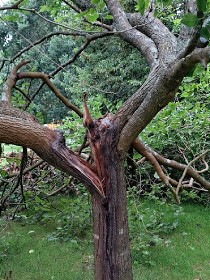 As a landowner, DDC has a duty of care to ensure that all trees on our land are maintained in an acceptable condition and do not pose an unreasonable risk to people or property.
DDC carries out regular inspections of trees to identify potential issues as early as possible, allowing preventative action to be taken where appropriate. Only essential works are undertaken to manage trees, and the type of work carried out depends on the tree’s location, species, and overall health.
DDC will carry out works to trees on our land if the issue relates to:
- the health of the tree – if the works are vital to the tree’s long-term survival. Dead, dying or diseased trees will only be removed when there is no other option
- the safety of the tree – if the tree has been identified as potentially hazardous or an immediate danger
- damage being caused by the tree e.g.– where branches are touching buildings, physical contact with walls, windows, gutters) or roots are resulting in structural damage
- a fallen tree
- loose limbs
DDC does not carry out works to a a tree if the problem is solely about:
- light or shading
- blocked TV signals
- falling leaves, fruit, seeds, pollen, bird droppings
- overhanging branches
If a tree owned by DDC has branches overhanging your garden and you wish to prune them back, DDC has no objection to you doing so. However, before carrying out any pruning, you must check whether the tree is protected by a Tree Preservation Order or is located within a Conservation Area.
If the tree is protected, you are legally required to obtain consent by submitting the appropriate application or notification before any work is undertaken.
Contact for tree enquiries
If you require any advice about trees, please contact Dover District Council: tree.enquiries@dover.gov.uk