
Your Tenancy Agreement is a legal contract between you and us (the council) and is designed to make sure you and other tenants are good neighbours and take proper care of the homes you rent.
It sets out some rules that you, and those who live in or visit your home, must keep to by law. The Tenancy Agreement gives you rights as well as responsibilities. It also lists the services you are entitled to in return for the rent you pay.
We recently updated some of the terms and conditions of your Tenancy Agreement to ensure it reflects current legislation, regulatory requirements and best practice, while clearly setting out the rights and responsibilities of both tenants and the council.
We posted a letter called a Notice of Variation informing you of this.
The updated Tenancy Agreement will be effective from the 24 August 2026. From this date, all council tenancies will be covered by the updated version.
Your can read the Tenancy Agreement below in both PDF and HTML format.
- Your Tenancy Agreement (opens in new tab)pdf file[368KB]
Your Tenancy Agreement
1.1 General
1.1.1 - This Tenancy Agreement (the 'Agreement') is an important legal contract. It sets out the rights and responsibilities of Dover District Council as the landlord, and of you as the tenant. By signing this Tenant Agreement, you are agreeing to become our tenant and abide by the terms and conditions of this Agreement. This is a legally binding contract with Dover District Council.
1.1.2 - Securely signing documents digitally will be treated as the legal equivalent of a handwritten signature for all purposes connected with this Tenancy Agreement. Secure signing documents may be used by the Council to facilitate the service, for example, but not limited to, sign-up, mutual exchange and termination.
1.1.3 - If there is anything within this Agreement that you do not understand, please contact the Housing Services team or seek legal advice before you sign it.
1.1.4 - We can take enforcement action against you if you break any of the conditions of this agreement. There is a range of legal action, but action could ultimately result in the termination of your tenancy and the loss of your home.
1.1.5 - The Council is not responsible for any loss of, or damage to, your personal possessions, furniture, or any other items you bring into the property, whether caused by fire, theft, flood or any other incident, unless this arises directly from our negligence. You are responsible for ensuring your personal possessions, furniture or any other items you bring into the property are adequately insured for the duration of your tenancy. Further information is available in the Tenant Handbook.
1.1.6 - As the tenant, or tenants, you will be responsible for any breach of the terms and conditions of this Agreement by members of your household, including lodgers, sub-tenants, children and visitors to the property whether inside the property or within your neighbourhood or shared areas (internal or external).
1.1.7 - On some occasions special conditions may apply to your tenancy. These may be personal to you or relate to the home you live in. We will tell you about these special conditions in your offer of tenancy.
1.1.8 - By signing this Agreement you also agree that officers managing your home may check the status of any benefit claim you may make to help you pay your rent.
1.1.9 - You must give us written permission for someone to act on your behalf. You can do this by contacting Housing Services by email: housing@dover.gov.uk or by phone: 01304 801084.
1.1.10 - A person who is not party to this Agreement is not intended to have any right under the Contract (Rights of Third Parties) Act 1999 to enforce any terms of this Agreement.
1.1.11 - For more information about Dover District Council's tenancies, please refer to the Tenant Handbook and the Council Housing webpages.
1.2 Introductory Tenants
Section 1.2 applies to introductory tenants only.
1.2.1 - Your Introductory Tenancy is granted pursuant to Part V of the Housing Act 1996.
1.2.2 - As an introductory tenant you do not have as many rights as secure tenants. Details of your rights under this agreement are set out in Section 2. While these show your legal rights, you may still be required to obtain our written permission or to notify us before you do some of them. Section 3.14 of this Agreement sets out where permissions or notifications are required.
1.2.3 - Introductory tenants living in Sheltered Accommodation have the same rights as other Introductory Tenants except where it is set out in this document.
1.2.4 - Your will start your tenancy as an introductory tenant unless, immediately before the tenancy starts, you are already a secure tenant or an assured tenant of a Private Registered Provider of Social Housing (housing association) or in the case of joint tenants, one of more, meets these conditions.
1.2.5 - Your tenant is a trial period intended for you to demonstrate to us that you are responsible enough to keep and sustain your tenancy. Your tenancy will last for 12 months. At the end of the period if you have not broken any of the tenancy conditions, ordinarily your tenancy will move to a Secure Tenancy.
If we want to extend or end your tenancy
1.2.7 - If during your Introductory Tenancy you break any of the tenancy conditions we can:
- Take action to end your tenancy and it is possible you will be evicted from your home. We can only end your tenancy with a court order. We will serve a 'Notice of Proceedings for Possession' on you if we are ending your tenancy. You can ask us to review our decision to seek and order for possession, OR
- We can extend your Introductory Tenancy by 6 months. We will issue you a 'Notice of Extension' where we are extending your tenancy. You can ask us to review our decision to extend the trial period.
1.2.8 - As an introductory tenant you do not have 'security of tenure'. This means that we can end your tenancy at the end of the 12 month period. We can only end your tenancy with a court order.
1.2.9 - If during your Introductory Tenancy you break any of the tenancy conditions, we may take action to end your tenancy, and it is possible you will be evicted from your home. We can only end your tenancy with a court order.
1.2.10 - We will serve Notice of Proceedings for Possession on you if we are ending your tenancy. You can ask us to review out decision to seek an order for possession.
1.2.11 - You must abide by the clauses set out in Section 3.13 of this Agreement if we end your tenancy. Please also refer to the Tenant Handbook for more information.
If you want to end your tenancy
1.2.12 - You, or the person authorised to act on your behalf (in which case valid proof of authority must be provided) can end your tenancy by notifying us in writing, giving us a minimum of 4 weeks' notice. All tenancies must end on a Sunday. Please note, that the notice period begins only once we have received written confirmation from you. In exceptional cases, you may be permitted to surrender your tenancy with less than 4 weeks' notice, but this must be agreed in writing by the Council.
1.2.13 - If you are a joint tenant, one tenant can end the tenancy by giving us notice. When this happens, the tenancy will end for both joint tenants. (Please see 3.13.3 for more details.)
1.2.14 - You must abide by the clauses set out in Section 3.13 of this Agreement when ending your tenancy. Please also refer to the Tenant Handbook for more information.
1.3 Secure Tenants
Section 1.3 applies to secure tenants only.
1.3.1 - Your Secure Tenancy is granted pursuant to Part IV of the Housing Act 1985.
1.3.2 - As a secure tenant your tenancy does not have an expiry date. We will not interfere with your right to live in your home unless any of the following applies (subject to the relevant legal provision):
- You break any of the conditions of this agreement
- Rent arreas
- Anti-social behaviour
- Being asked to downsize after a tenant's death
- You do not need the disability adaptations in the property.
- Not telling the truth on your application
- Demolition, major repairs and redevelopment
- You make your home overcrowded
- You do not live in your home
- There is any other reason under the Housing Act 1985 or any other housing law or regulation, which allows us to interfere with your rights to live in the property.
1.3.3 - Section 2 of this Agreement provides a summary of your legal rights as a secure tenant. You can find our more on your legal rights as a tenant in the Tenant Handbook. While these show your legal rights, you may still be required to obtain our written permission or to notify us before you do some of them. Section 3.14 of this Agreement sets out where permissions or notifications are required.
1.3.4 - Secure tenants living in Sheltered Accommodation have the same rights as other secure tenants except where it is set out in this document.
If we want to end your tenancy
1.3.5 - We will serve a Notice of Seeking Possession on you. We cannot evict you from your home unless a court of law determines that there is a valid legal reason to do so.
1.3.6 - You must abide by the clauses set out in Section 3.13 of this Agreement if we end your tenancy. Please also refer to the Tenant Handbook for more information.
If you want to end your tenancy
1.3.7 - You, or the person authorised to act on your behalf (in which case valid proof of authority must be provided) can end your tenant by notifying us in writing, giving us a minimum of 4 weeks' notice. All tenancies must end on a Sunday. Please note, that the notice period begins only once we have received written confirmation from you. In exceptional cases, you may be permitted to surrender your tenancy with less than 4 weeks' notice, but this must be agreed in writing by the Council.
1.3.8 - If you are a joint tenant, one tenant can end the tenancy by giving us notice. When this happens, the tenancy will end for both tenants. (please see clause 3.13.3 for more details).
1.3.9 - You must abide by the clauses set out in Section 3.13 of this Agreement when ending your tenancy. Please also refer to the Tenant Handbook for more information.
Section 3.0 onwards applies to both introductory and secure tenants, unless stated otherwise.
3.1 Paying your rent and money owed to the Council
3.1.1 - You must pay your rent (which may include service charges as part of the rent), and you must pay it on time. Your rent is due every week from the date at the beginning of this Agreement and must be paid every Monday in advance. If you prefer to pay fortnightly or monthly, you must still make sure that you pay your rent in advance.
3.1.2 - If you are joint tenants, you are each responsible for paying all rent and charges when they are due. If one joint tenant leaves the property, both will still be equally responsible for any rent or changes until the joint tenancy ends.
3.1.3 - If you believe you are entitled to Housing Benefit, Universal Credit, or any other financial support in paying your rent, it is your responsibility to claim this and to have a bank account for this money to be paid into. You must ensure that you provide all the information requested to process your claim and that you notify the relevant authority of any change or circumstance as required.
3.1.4 - If you have difficulty paying your rent, you or your authorised person with permission to act on your behalf must contact us immediately.
3.1.5 - If you do not pay your rent, persistently pay it late, or do not pay rent arrears, we can begin court proceedings to seek an order for possession of your property. These proceedings may incur additional charges such as court fees and legal costs that you may be ordered to pay.
3.1.6 - If you are evicted because you do not pay your rent this may affect your chances of being rehoused by us or another social landlord.
3.1.7 - If your tenancy ends you must pay the rent and / or costs which you owe in full. If you are joint tenants, we can recover all money owed to us from either of you or both of you.
3.1.8 - If any money is to be paid to you by the Council as your landlord, the Council reserves the right to deduct any debts or charges owed by you to the Council including rent arrears, other costs, or outstanding Court costs.
3.1.9 - A rent statement can be requested from us if you require one. Please see the Tenant Handbook for further details.
3.1.10 - You are responsible for arranging the utility supply and services to you home, and for ensuring timely payment of any associated bills.
3.2 Living in your home
3.2.1 - You must not use the property for anything other than a private home.
3.2.2 - You must always keep the property clean and in good condition.
3.2.3 - You must live at the property, and it must be your only or principal home. If the property ceases to be your only and principal home or you are away from your home for more than 28 days (and have told us), we can end your tenancy by serving a Notice to Quit. We may simultaneously serve a Notice of Seeking Possession, then begin proceedings for possession of the property. If you are claiming help to pay your rent, you must ensure that you comply with benefit rules during the period you are away.
3.2.4 - You must tell us if you will be away from your home for 28 days or more in writing, telling us the dates of your absence and the name and contact details of a nominated key holder in case of emergencies. If you are unable to notify us directly, for example due to medical reasons, you must ask an authorised person to act on your behalf to contact us.
3.2.5 - You must take all reasonable measures to ensure that, during any period of absence from your property, it is adequately secured to prevent unauthorised access. You must ensure that the property is always heated adequately and that the water is turned off at the mains if you will be away for long periods during cold weather. You must also make proper arrangements for the care and welfare of any animals at the property. Failure to do any of the above could result in being recharged for any remedial works because of damage, or any costs incurred for the welfare of any animals.
3.2.6 - You must not allow your home to be overcrowded (as defined under Part X of the Housing Act 1985). We can apply for a possession order if we find that your property is overcrowded. This does not apply to overcrowding arising from the natural growth of a family, but you must notify us if your home is overcrowded so that appropriate arrangements can be made.
3.2.7 - If you have a garage included within your tenancy, these conditions apply, and homes should be read to include the garage (as defined in Section 5.0).
3.3 Anti-social behaviour
3.3.1 - You must be considerate of your neighbours and not unreasonably interfere with their enjoyment of their property.
3.3.2 - You are responsible for the behaviour of all members of your household, including your children and any lodgers, subtenants or visitors. This applies to your home, in your neighbourhood and shared areas (internal and external).
3.3.3 - You must not harass, intimidate, abuse of cause a nuisance, annoyance or disturbance to neighbours, residents, visitors to the area, Council staff, contractors, operatives or agents acting on our behalf, living in, visiting or engaging in a lawful activity in your home, in your neighbourhood and shared areas (internal and external).
Examples of behaviour that might be considered to be causing harassment, intimidation and abuse include but are not limited to:
- Physical or verbal abuse
- Threatening behaviour
- Stalking
- Writing threatening or abusive material including graffiti
- Making false or malicious complaints about the behaviour of any other person.
Examples of behaviour that might be considered to be causing a nuisance, annoyance of disturbance include but are not limited to:
- Causing unreasonable noise such as playing loud music, shouting or screaming, door slamming
- Installing laminate flooring in flats without suitable noise insulation, that then cause noise nuisance to neighbours
- Banging on floors or party walls
- Threatening or intimidating behaviour
- Arguing, fighting, swearing, using offensive language, drunken behaviour
- Physical violence or assault
- Stalking
- Persistent or offensive phone calls, texts and / or emails
- Sending indecent or abusive materials
- Posting and sending offensive material on social media
- Cyber bullying or trolling
- Deliberate damage to property or another person's home or possessions
- Graffiti and writing threatening and / or abusive material
- Allowing your animals to foul in shared areas and failing to clear up after them
- Selling, cultivating, or using drugs or committing other criminal behaviour
- Dumping or hoarding rubbish either on shared areas / spaces or in your own garden or property. This includes items of household furniture, appliances of car parts
- Keeping your garden in an untidy state so that it is unkempt and attracts vermin
- Plants and / or trees causing a nuisance and / or damage to neighbouring properties / land
- Driving vehicles dangerously in the local area
- Carrying out extensive repairs to any vehicle in gardens, garage areas, parking bays or estate roads or verges to cause a nuisance to others
- Driving mini motorcycles in public spaces and shared areas
- Any pet or animal which causes or is likely to cause a nuisance, annoyance or disturbance to neighbours or others living in the neighbourhood
3.3.4 - If we believe it is appropriate, we can ask you to attend mediation to help resolve a neighbour dispute. You must not unreasonably refuse to attend such mediation if you are asked to do so.
3.3.5 - You must not discriminate against anyone residing, visiting or engaging in lawful activity in your home or neighbourhood. Such actions, or even perceptions of them, can be classified as hate crimes and could constitute a criminal offence. We can take action against you if you have committed a hate crime. Please see the Tenant Handbook for more information.
3.3.6 - You must not use your home, your neighbourhood or shared areas (internal and external) for any criminal or immoral purposes. This includes but is not limited to:
- Cultivating, selling, using, possessing or storing drugs
- Selling alcohol, tobacco or fake goods
- Using the property to store stolen goods
- Dealing in pornography
- Prostitution and / or brothels
- Keeping illegal or unlicensed firearms or weapons at the property
3.4 Domestic abuse
3.4.1 - You must not engage in, permit, or cause any acts of domestic abuse towards any person (including children) residing in or visiting the property, in your neighbourhood including shared areas. This includes, but is not limited to:
- Physical or sexual abuse
- Violent or threatening behaviour
- Controlling or coercive behaviour
- Economic abuse
- Psychological, emotional or other abuse
3.4.2 - A breach of this clause can result in action being taken against you, including taking steps to evict you. We can also ask another agency to take actions, such as the Police.
3.4.3 - If your behaviour causes someone, including their children, to leave your home, we may pursue legal action against you. This could ultimately result in us evicting you from your home.
3.5 Tenancy fraud
3.5.1 - You must not engage in, commit, or attempt to commit any type of tenancy fraud. Examples of tenancy fraud are found in the Tenant Handbook.
3.5.2 - We can take legal action if you engage in, commit, or attempt to commit tenancy fraud. This could include ending your tenancy and asking the court to give us possession of your home.
3.6 Repairs, improvements and making alterations to your home
Introductory tenants and Sheltered Accommodation tenants (both introductory and secure) cannot make alterations or improvements to the home. This restriction does not apply to disability-related adaptations requests, supported by an occupational therapist and under our consideration.
3.6.1 - You will not need our written permission for internal decorating of the property, but you cannot make any alterations and improvements to your home without our written permission (see Section 3.14).
3.6.2 - Emergency repairs (as defined in Section 5.0) must be reported immediately using the emergency repairs service. For details of how to do this, please refer to the Tenant Handbook.
3.6.3 - You must let us know of any repair needed, or any damage cause to the property or signs of damp and mould, within a reasonable time of you becoming aware of it.
3.6.4 - You must not damage or destroy the fabric of the building or any fixtures and fittings at the property. You will be liable to pay for damage caused by your actions to any part of the property or shared areas (internal and external).
3.6.5 - You are responsible for carrying out some internal repairs to your home at your own expense. Examples of the type of repair we consider to be the tenants' responsibility can be found in the Tenant Handbook.
3.6.6 - You are responsible for maintaining the internal decoration of the property to a reasonable standard. Please see the Tenant Handbook for further details.
3.6.7 - We can take legal action, for example, asking the Court to give us possession or to grant an injunction because work needs to be done to the property. This may happen where you have caused damage or caused the condition of the property to deteriorate or where we need to carry out major repairs, redevelop or demolish the property.
3.6.8 - You can be charged for any repairs or maintenance required where damage has occurred, or where the condition of the property and shared areas (if applicable) has deteriorated (i.e., neglect as well as damage) and:
- you are responsible for the repair, but we have had to carry them out because you have not done them
- you have not complied with the terms of any permission granted
- you did not obtain our written permission
3.6.9 - You are responsible for the actions of any persons you allow into the property and will be liable to pay for damage caused by their actions to any part of the property or shared areas (internal and external).
3.6.10 - In the event that we require your home to undergo major repairs, redevelopment, or refurbishment, you may be offered temporary alternative accommodation (please see 'Temporary Move property' definition in Section 5.0) under a separate temporary agreement. Your rights under this Tenancy shall remain unaffected. You are expected to return to your main home once the works are complete. Where you cannot return to your home you will be offered suitable permanent accommodation.
3.7 Access to your home
3.7.1 - You must allow our staff, contractors, operatives or agents acting on our behalf to enter the property at reasonable hours on requests for the purposes of inspecting the property or carrying out any works. You must allow our employees and people we authorise into your home to:
- Carry out an inspection
- Carry out tenancy or property audits
- Carry out a welfare visit
- Carry out a gas safety check
- Carry out a Fire Risk Assessment (FRA)
- Carry out an electrical safety check
- Carry out water hygiene tests / checks that may be necessary
- Carry out lifting equipment checks
- Carry out smoke detector and / or carbon monoxide alarm checks
- Carry out repairs or improvements that may be necessary
- Inspect a neighbouring property
- Discuss any issues relating to your tenancy
3.7.2 - Unless otherwise agreed or it is an emergency or we are investigating alleged tenancy breaches, we will give you at least 24 hours' notice.
3.8 Gardens
3.8.1 - You must keep your garden (if you have one) in a reasonable, tidy and safe condition (for example, but not limited to, ensuring the grass is cut), it must not become a nuisance to other neighbours, and must be free from household waste, rubbish and weeds.
3.8.2 - You must inform us as soon as is reasonably practical if you are unable to maintain your garden to a reasonable standard.
3.8.3 - You must not allow any hedge or tree to grow to cause a nuisance to overhang neighbouring land, including but not limited to, pavements and gardens.
3.8.4 - You are responsible for the upkeep of trees within your garden, including maintaining them, preventing damage, and reporting any damage to buildings.
3.8.5 - You must not use the garden to store, load or unload materials, including but not limited to, scrap metal and bulk items.
3.8.6 - If you fail to look after your garden, we can take legal action against you.
3.8.7 - It is your responsibility to ensure that your garden is maintained and not overgrown if you intend to be away from the property for a long period of time (please see clauses 3.2.3 & 3.2.4).
3.9 Vehicles and parking
3.9.1 - You must only park your vehicle in designated parking areas owned and / or managed by the Council, or an area intended for parking.
3.9.2 - You must not drive across a kerb to access your property unless it has been dropped in accordance with the regulations of the Highway Authority.
3.9.3 - If you have registered your vehicle as SORN with the DVLA, you cannot park it on a public highway or designated parking areas owned and / or managed by the Council, or an area intended for parking.
3.9.4 - You must not abandon any vehicle (as defined in Section 5.0) in any designated parking areas owned and / or manage by the Council, or an area intended for parking. We can take steps to remove abandoned vehicles, and we can charge the costs of removal to you or the registered owner.
3.9.5 - You must not allow anyone to sleep in, live in or occupy any vehicle (as defined in Section 5.0), in designated parking areas owned and / or managed by the Council, or an area intended for parking.
3.9.6 - You must not park or leave a vehicle (as defined in Section 5.0) anywhere that can block access for any vehicles.
3.10 Household waste and recycling
3.10.1 - You must ensure that your household waste and recycling is put out ready for collection in accordance with the Council's waste collection and recycling service, in relevant receptacles.
3.10.2 - If you live in a flat or maisonette, you may be expected to deposit rubbish in the bins provided in the designated area. You must use these bins and not leave household waste in any other parts of the internal or external share areas.
3.10.3 - You must not leave of dispose of household waste, rubbish or recycling in any shared areas (internal or external), your garden or your neighbourhood.
3.10.4 - We can recharge you for the costs of clearing any household waste, rubbish or recycling that you have not disposed of correctly.
3.10.5 - You must dispose of non-household waste (as defined in Section 5.0) appropriately. Non-household waste must not be placed in Council provided waste and recycling receptacles, or designated waste and recycling areas. You are responsible for arranging disposing of these items appropriately, for example, at your local household waste and recycling centre yourself, or using the Council's chargeable bulk waste collection service.
3.11 Keeping animals and pets
3.11.1 - You must have our written permission to keep any animal or pet (including assistance dogs) in your home (please see Section 3.14).
3.11.2 - You must not keep or bring the following animals to the property:
- Any dog the Dangerous Dogs Act 1991 applies to, unless there is an exemption
- Any animal the Dangerous Wild Animals Act 1976 applies to
- Any dangerous animal
- Any animal which causes a health and safety risk in the area
- Any animal which is not bred to be a domestic pet
- Cockerels
3.11.3 - You must ensure that any animal or pet kept at your home does not prevent a Council officer, contractor, operatives, or agents acting on behalf of the Council from gaining access to your home, and that all animals and pets are kept under control to allow such access. If requested, the animal or pet should be removed from the work area to a secure room or outside the property.
3.11.4 - You must not leave any animal or pet in your home without property arrangements being made for its care or welfare when your are away from your home. You must not leave any animal or pet in your home when you move out of the property.
3.12 Health & Safety and Hygiene
3.12.1 - You must not tamper with the gas, electricity and water supplies or with meter(s) in your home, or in any shared areas (internal and external).
3.12.2 - We will carry out a gas safety check every year in compliance with health and safety legislation and regulations. You must allow us access to your home to complete this (please see 3.7 Access to your property, and clauses 4.1.5 & 4.1.6).
3.12.3 - You must not keep any potentially hazardous goods or materials or substances in your home or any shared areas (internal and external), except those required for general household use in which case these must be stored in accordance with the manufacturer's instructions.
3.12.4 - You must not store or charge any mobility scooter, e-scooter or battery, petrol or diesel powered vehicle or machinery in your home or any shared areas (internal and external), without our written permission (please see 3.14 Permissions).
3.12.5 - You must not store any items, such as rubbish, furniture, belongings, prams and bicycles, in any shared areas (internal and external) as these impede fire escape routes.
3.12.6 - You must not interfere with any health and safety equipment, such as fire alarms, smoke detectors or carbon monoxide detectors in your home, the premises and shared areas (internal and external).
3.12.7 - You must not put anything on a window ledge, balcony or roof, including covers and nettings, which could cause a fire, fall from height or be a danger to other individuals.
3.12.8 - You must not, through feeding wild animals or birds (i.e., pigeons, seagulls, foxes etc), cause a nuisance or annoyance to your neighbours, cause damage to the building or excessive cleaning.
3.13 When your tenancy ends
The below conditions apply whether you or we have ended your tenancy.
3.13.1 - If you have given notice to end your tenancy, you must allow Council staff, contractors, operatives or agents acting on our behalf, access to the property (at a pre-arranged date) for an inspection. We will give no less than 48 hours notice of any visit in this circumstance, unless otherwise agreed.
3.13.2 - You or your representative must return all keys (home keys, shared area keys, fobs) to us by 12pm on the Monday immediately or otherwise arrange, following the end of your tenancy (all tenancies end on a Sunday). If you, or your representatives fail to return the keys by this time, you will be charged for changing the locks and / or charged for use and occupation until you do. You can return your keys and vacate the property before the end of your notice period, but you will still be charged for the whole notice period.
3.13.3 - If you are joint tenants, either of your can end the tenancy by giving us notice of termination. This will end the tenancy for both tenants regardless of who has given notice. We will use the relevant policies to decide if the other joint tenant can stay in the property with a new Tenancy Agreement. There is no automatic right for the other joint tenant to stay in the property.
3.13.4 - You must leave the property, the fixtures and fittings and any furnishings we have provided in a good and clean condition (factoring in reasonable wear and tear). Any damage (however caused) must be repaired. If you fail to repair any damage you must pay the costs incurred by the Council in carrying out those repairs. This also includes rectifying any alterations, improvements or additions you have made with or without the Council's permission, or which have not bee carried out correctly or to the correct standard.
3.13.5 - You must ensure that the property, including all gardens, patios, side entrances, lean-tos, alleyways, cellars, sheds, lofts, roof space, outbuildings and any shared areas (internal and external) are left clean, tidy and completely cleared of any furniture, personal belongings, white goods and rubbish. If you leave the property in an unclean or untidy condition, you will be responsible for all costs of any cleaning, redecoration, clearance, disposal or storage (on a case-by-case basis) undertaken and paid for by the Council.
3.13.6 - Any items that are left in the property, garage, gardens, sheds or outbuildings will be regarded as unwanted and will be disposed of. You will be recharged for the disposal of these items.
3.13.7 - You must remove any greenhouse, garage, shed, decking or other structure and fill in ponds your have put in your garden unless we agree in writing that you can leave it. If you do not, we will remove them and recharge you for doing so.
3.13.8 - You must not leave any person, pet or animal in the property when you move out. If you do not intend to keep your pet or animal when you move, it is your responsibility to organise its rehoming. You will be recharged if we have rehomed an abandoned pet or animal. If we take legal action you may have to pay our legal costs.
3.13.9 - You must pay your rent in full before you leave. If you cannot clear your rent, you must ensure you leave a forwarding address and arrange to pay the balance.
3.13.10 - You must notify utility companies and provide them with a copy of your meter reading(s) at the point you move out of your property, or you may incur additional charges. You must ensure you clear any outstanding debt before you leave the property.
3.13.11 - You will be responsible for paying the rent and / or a charge for use and occupation until whichever of the following dates is the latest:
- The date upon which any notice to terminate expires; or
- The date upon which you leave the property and give back vacant possession of the property; or
- In the event of you failing to give written notice or to return the keys, or you do not give vacant possession the date upon which the Council takes possession
3.13.12 - If you leave the property owing rent or use and occupation charges, this may affect whether you are offered another Council tenancy in the future. If you are later granted another Council tenancy, you agree that any outstanding rent or use and occupation charges may be transferred to your new tenancy and added to your consolidated rent account.
3.14 Permissions
3.14.1 - You must obtain our written permission for the following points. If we grant permission, you will be subject to specific terms and conditions outlined in our written approval. If you do not abide by the terms and conditions, we can remove the permission and / or take enforcement action against you.
- If you want to run a business or non-profit form your home. We will not unreasonably refuse permission unless the business of non-profit would cause a nuisance to your neighbours or cause damage to the property or shared areas (internal and external) In addition to obtaining our permission, you may also need to secure any necessary planning permissions.
- If you want to exchange your home with another social housing tenant. Restrictions apply.
- Introductory tenants cannot exchange their home with another social housing tenant.
- Sheltered Accommodation tenants can only exchange with another tenant eligible for the scheme.
- If you want to sublet part of your property or take in a lodger. We will always refuse permission if the property would become overcrowded, or, in the case of Sheltered Accommodation, if the lodger would not be eligible to live at the property.
- Introductory tenants cannot take in lodgers or sublet part of their property.
- Sheltered Accommodation (secure) tenants cannot sublet part of their property
- If you want to keep any animals or pets in your home, including assistance dogs. When considering granting permission we will take the following into account:
- The number, type, size and breeds of your pet
- The type and number of pets already living in your home
- The type and size of your home
- The number of people living in your home
- Proximity and access to roads, green spaces and outdoor areas
- Whether your home is a sheltered housing scheme
- Any legislative or licensing requirements or regulatory obligations
- Any prior history of anti-social behaviour, rent arrears or any other tenancy breaches
You will be required to remove any animal or pet kept without our permission or any animal or pet deemed unsuitable or causing a nuisance. Failure to comply may result in your animal(s) or pet(s) being removed from your home and / or could include action to end your tenancy.
Your permission will cease when your animal(s) or pet(s) passes away or no longer lives in your home. You will need to reapply for permission for any new animal or pet you want to keep, or your animal or pet returns to your home.
- If you want to make any improvements and / or alterations (as defined in Section 5.0) to the property. We will not give permission until evidence has been received that you have the necessary building regulations and / or planning permissions.
- Both introductory tenants and tenants in Sheltered Accommodation cannot make improvements and / or alterations to their home.
- If you want to erect a greenhouse, garage, shed, fishpond, swimming pool or hard-standing hot-tub in your garden or balcony.
- If you want to remove, alter, install or replace any hedge, fence, wall or the boundary of the property.
- If you want to plant or remove any trees that are within the boundary of your home. Please note, for trees protected by law you will require written consent from the local planning authority.
- If you want to alter any external shared gardens or areas, subject to consultation.
- If you want to use the loft / attic space in your home for example, but not limited to, storage. We will not grant you permission to use the loft / attic space as accommodation or a living area.
- If you want to store or charge any battery, petrol or diesel operated vehicles, including mobility scooters and e-bikes, or machinery, in your home and / or a shared space (internal and external).
3.14.2 - It would be unlikely that we would grant you permission if doing so will:
- Cause a nuisance or annoy your neighbours
- Cause damage to your property, or neighbouring properties
- Cause health and safety risks
3.14.3 - Other reasons may apply. We will not unduly withhold our permission without clear and valid reasons. We also reserve the right to withdraw our permission at any time if you fail to comply with the conditions. Please refer to the Tenant Handbook on how you can request permission.
4.1 Repairs and maintenance
4.1.1 - We will carry out repairs we are responsible for within a reasonable time and where applicable in accordance with the prescribed period, giving priority to urgent repairs as set out in the Tenant Handbook.
4.1.2 - We will maintain the structure of your home which includes but is not limited to:
- The roof
- External drains, rainwater goods and pipes
- External walls and doors, windowsills, window frames
- Internal walls, skirting board, door frames, floors and ceilings - excluding decoration but includes major plasterwork
- Fences - which border a public highway, path or playing field
4.1.3 - We will keep all installations in the property for the supply of water, gas, electricity, sanitation, space and for water heating in repair and property working order. Pease note that meters are the responsibility of the supplier of the services.
4.1.4 - In shared areas (internal and external), we will take reasonable steps to keep all lifts, lighting, door entry systems, fire safety equipment and other shared items in a reasonable state of repair.
4.1.5 - We will carry out a gas safety check of your home every year if your home has gas. We will try to arrange this at a time that suits you. You can rearrange the check with us, but you must allow us, our contractors, operatives or agents acting on our behalf, access to your home to complete this check (see Section 3.7). If we cannot carry out the safety check because your do not respond to our request to access your home, we will serve notice on you telling you when we will visit. If you do not let us in to complete the safety check, we will force entry into your home. We will take reasonable care in forcing entry and your home will be properly secured and repaired as necessary as we leave. If we have had to force entry because of your failure, carelessness or negligence you will be charged the cost of the repairs.
4.1.6 - In an emergency we may have no alternative but to enter your home without notice by any means necessary, including the use of forced entry. We will take reasonable care in forcing entry and your home will be properly secured and repaired as necessary as we leave. If we have had to force entry because of your carelessness or negligence you will be charged the cost of the repairs.
4.1.7 - Where additions or improvements have been made, we will only maintain and repair them if we have agreed to do so in writing.
4.1.8 - If you cause damage to the property, we can ask you to repair the damage, or we may carry out the repairs and charge you for them.
4.1.9 - If you apply to buy your home through Right to Buy, we will only carry out repairs that we have a legal duty to do, like gas and electrical safety or water problems. No further improvements will be made to your home while your application is ongoing.
4.1.10 - We will keep shared areas (internal and external) in a reasonable decorative state.
4.1.11 - We will only make good on any internal decorative finishes affected by any improvement works carried out by the Council or contractors, operative or agents acting on our behalf.
4.1.12 - We will make good on any repair works (for which we are responsible) carried out by the Council, contractors, operatives or agents acting on our behalf.
4.2 Managing your tenancy
4.2.1 - We will send you a rent variation notice giving you 4 weeks notice of any changes to your rent or other charges. We will make changes to your rent even if you do not receive the notice.
4.2.2 - We can provide you copies of a link to our housing strategies and policies if you ask for them.
4.2.3 - If you tell us you are disabled or vulnerable, we can make reasonable adjustments to the services we provide to meet your needs if you require them.
4.2.4 - We can give you help and advise if you tell us that you are a victim of anti-social behaviour or a hate incident.
4.2.5 - We can give you help and advice if you tell us that you are a victim / survivor of domestic abuse.
4.2.6 - If you behave unacceptably towards a member of our staff, contractors, operatives or agents acting on our behalf, we can take actions to restrict or limit your contact with us.
4.2.7 - We will consult you about changes to the way we plan to manage, maintain and improve Council homes. We will also consult you about changes to the services and facilities we offer to tenants.
4.2.8 - In some cases when you die it is possible for your tenancy to be passed on to another eligible family member. This is called succession. The rules relating to succession are set out in legislation and the Tenant Handbook. We can provide you information if you ask for it.
4.3 Data protection
4.3.1 - In accordance with the UK General Data Protection Regulation (GDPR) and the Data Protection Act 2018, we will collect and store your personal information your provide to us securely and confidentially.
4.3.2 - We will collect and process personal data about you and household members for the purposes of:
- Managing the tenancy and property
- Ensuring compliance with legal and regulatory obligations
- Delivering housing related services
- Monitoring and improving service quality
- Complying with the Regulator of Social Housing's data requirements
4.3.3 - We will collect personal information from you to help us provide you with the most appropriate service and we may share this information with other Council departments, and other organisations where appropriate. Information that was collected for one purpose may be used for another Council or another legitimate purpose, unless there are legal restrictions preventing this.
4.3.4 - Personal data will be processed under the following lawful bases:
- Performance of a contract (the Tenancy Agreement)
- Legal obligations (e.g., housing regulation, safeguarding, crime)
- Legitimate interests (e.g., service improvement, fraud protection)
- Consent (where required, e.g., for optional services)
4.3.5 - We have implemented appropriate technical and organisational measures to protect personal data that we collect and store about you and members of your household.
4.3.6 - Personal data collected for the purposes details within the Tenancy Agreement will be retained for as long as necessary to fulfil the purposes outlined within the Housing retention policy.
4.3.7 - The UK GDPR and Data Protection Act 2018 provide you certain rights relating to the information we hold about you. You have the right to:
- Access your own person data, including any of the information you have given us in connection with your tenancy
- Request correction of inaccurate data
- Request deletion of your personal data
- Object to or restrict our use of your personal data
4.3.8 - If you want to see a copy of the information we hold about you, please contact the Data Protection Officer using the contact details below. For further information about how your personal data is processed, shared and protected, please visit our website to view our Corporate and Housing Services Privacy Notice at www.dover.gov.uk/privacy.
You can contact the Council's Data Protection Officer at:
Post: Data Protection Officer, Dover District Council, Council Offices, White Cliffs Business Park, Whitfield, Dover, CT16 3PJ.
Email: dataprotection@dover.gov.uk
Tel: 01304 872426
4.4 Notices
Service of notices by the Council
4.4.1 - Any notices we need to serve to tell you about changes to your rent or your tenancy will generally be served by posting them through your letterbox. We can serve any notice on you at the property by putting it through the letterbox, by fixing it to the property, by sending it by recorded delivery, first class post, by leaving it with you or somebody at your home or by sending it to, or leaving it at, your last known address. We may also send a copy of documents to you by email, using the email address you have provided us.
Service of notices by the Tenant(s)
4.4.2 - If you wish to serve notice on the Council it should be served using the following methods:
In person: the reception desk at Dover District Council, Council Offices, White Cliffs Business Park, Whitfield, Dover, CT16 3PJ
By post: Housing Services, Dover District Council, Council Offices, White Cliffs Business Park, Whitfield, Dover, CT16 3PJ
By email: housing@dover.gov.uk, only if we have agreed in writing that you can serve notice in this way
Securely signing documents digitally / customer portal
4.4.3 - Where appropriate the Council offers digitally secure systems to facilitate the sending and / or serving of document relating to managing your tenancy.
4.5 Complaints
4.5.1 - You can make a complaint to us if you think we have broken any of the terms of this agreement. We will arrange to investigate your complaint and write to you with the result. Details of how you can raise a complaint can be found in the Tenant Handbook.
4.5.2 - If your complaint is about a repair not being completed within the agreed time limits, you can use your right of repair. Details of this are provided in the Tenant Handbook.
4.5.3 - If you are still unhappy with the way we have dealt with your complaint you can refer the matter to the Housing Ombudsman. You can also contact your local Citizens Advice Bureau, Shelter, other advice centres or a solicitor for information about your rights.
Abandonment – where a tenant leaves the home without formally ending the tenancy and without clear intention to return. This may include leaving the property empty for an extended period without notifying the Council, stopping rent payments or removing personal belongings. Key indicators of abandonment include:
- No response to our communications or visits
- No utilities usage over time
- Neighbours reporting prolonged absence
- Property appears vacant or unoccupied
Agreement – this refers to this Tenancy Agreement and the terms and conditions.
Alterations and improvements – refer to changes made to a property that go beyond simple decoration. These can include structural changes or installations that alter the function or appearance of the home. Some examples include, but are not limited to:
- Constructing, removing or demolishing walls or structures
- Installing showers or other fixed appliances
- Installing laminate flooring (any home type)
- Laying down patios or decking
- Building extensions
- Altering or replacing fixtures and fittings provided by the Council
- Making changes to essential gas, electricity or water services
- Erecting aerials, satellite dishes, solar panels, sheds, garages, pigeon lofts, car ports, hardstanding, or driveways
- Removing trees, hedges fences or walls from gardens or external areas
- Altering the boundary of the property
- Installing an Electric Vehicle (EV) charging point
These types of alterations and improvements will require permission (see section 3.14) and may involve compliance with local regulations.
Anti-social behaviour – means conduct that:
- has caused, or is likely to cause, harassment, alarm or distress to any person.
- can cause nuisance or annoyance to a person in relation to that person’s occupation of residential premises, or
- Can cause housing-related nuisance or annoyance to any person.
Assignment – is a way that a tenant can transfer their tenancy to another eligible person. On assignment, the assignor’s legal interest in a property is passed to the assignee who takes over that interest and becomes the tenant. All the terms of the original Tenancy Agreement apply to both the new tenant and the landlord, including the amount of rent payable. Tenancies can only be assigned once.
Contractors, operatives and / or agents – a person or company who undertake work and / or services on behalf of Dover District Council.
Council or the Council – refers to Dover District Council.
Court costs – costs incurred by the Council for legal proceedings and granted by the court as rechargeable against the tenant.
Designated parking area(s) – a piece of land that is used primarily for parking. A permit is sometimes required to park. The land will either be within a defined boundary or be an established parking area. This does not include parking bays / driveways within the boundary of the property.
Domestic Abuse – an incident or pattern of incidents of physical or sexual abuse, violent or threatening behaviour, controlling or coercive behaviour, economic abuse, or psychological, emotional or other abuse to an individual 16 years or older.
Driveway – a private area in front of your house or other building onto which you can drive and park your vehicle.
Emergency (including emergency repair and / or emergency hazard) – a repair required to remedy a fault that poses an immediate risk to health, safety, or security of a resident or others, or that could cause serious damage to the structure of the property if not addressed without delay.
Eviction – is the legal act of removing a tenant from a rented property, typically initiated by the landlord when the tenant breaches the tenancy—such as by failing to pay rent, causing damage, or engaging in unlawful activity. This process must follow specific legal procedures, including formal notice and, in many cases, a court order, before the landlord can reclaim possession of the premises.
Fixtures and fittings – all our appliances and furnishings in the property, including installations for supplying or using gas, electricity and water.
Flat – a home which forms part of a building.
Garden – refers to the garden area that forms part of the property. It can include lawns, hedges, flowerbeds, trees, fences, paths and yards
Hate crime – any incident which constitutes a criminal offence, which is perceived by the victim or any other person as being motivated by hostility of prejudice, based on a person’s disability or perceived disability; race or perceived race; religion or perceived religion; sexual orientation or perceived sexual orientation, or transgender identity or perceived transgender identity.
Household – you and anyone living permanently in the property.
Introductory Tenancy – a probationary tenancy that is used for the first year that you are a tenant with us. It can be extended by 6 months or ended at the end of the 12-month tenancy period.
Joint tenant – this is when the tenancy has been granted to more than one person.
Landlord – Dover District Council
Lodger – this is a person that you give a license to share all or part of the property, they may pay you for this. They are not sub-tenants.
Maisonette – a flat with more than one floor.
Major works – refer to changes or upgrades made to the property by the Council at its discretion, typically to improve the property’s condition or functionality. Improvements can go beyond standard repairs or maintenance and may be intended to meet legal standards. Examples include:
- Renovating kitchens or bathrooms
- Upgrading heating, plumbing or electrical systems
- Installing new fixtures or appliances
- Improving insulation or energy efficiency
- Making disabled adaptations or modifications
Mutual Exchange – you may be entitled to swap your tenancy with another Dover District Council tenant or a tenant from another council or housing association.
Neighbourhood / locality – the areas and shared areas around the homes that the Council manages, including the wider community where tenants live.
Non-household waste - refers to any waste not ordinarily produced through day-to-day domestic use of the home. This includes commercial or business waste, building or DIY materials, rubble, soil, white goods, furniture, large electrical items, excessive cardboard or packaging from bulk deliveries, scrap metal, clinical waste, hazardous waste including asbestos, waste cooking oil, motor oil or grease, fuel (petrol, diesel, paraffin, kerosene, heating oil or similar), solvents, paint, weed killer, garden waste and any waste resulting from activities other than normal household living.
Notice to Quit (NtQ) – a formal declaration by the tenant(s) or the Council to end the tenancy. The Notice is legally binding.
Notice of Proceedings for Possession – is a formal notice from the Council telling the tenant that the Council intends to start legal action to take back the property.
Notice of Seeking Possession (NoSP) – is a formal notice from the Council to the tenant(s) informing them we intend to take back possession of the home.
Partner - A husband, wife or civil partner or someone who lives with you as a husband or wife, or in a same sex relationship
Permitted number – this is the maximum number of people that are allowed to live in the property. When counting the number of people living in the accommodation anyone under 10 years of age counts as half (0.5) and any child under one year of age does not count at all.
Property / Home – this includes your home (the address of which is detailed on the front of this Tenancy Agreement) plus any garden, yard, balcony, outbuilding, fence, wall or driveway let with it, for which you are the tenant(s). This does not include any shared area (internal or external). This includes a garage where it is included as part of the Tenancy Agreement.
Relative - parents, children, grandparents, grandchildren, brothers, sisters, uncles, aunts, nephews, nieces, cousins and step relatives.
Rent – the weekly charge we ask you to pay for occupying the property. Other charges (service charges) may be included in the total weekly rent for extra services.
Right to repair – this is a government standard for the repairs that we must do for you. Information about this can be found on our website: Right to repair.
Secure Tenancy – the type of tenancy you get after being an Introductory Tenant. A Secure Tenant has more rights than an Introductory Tenant.
Service charges – these are charges for services that are provided in addition your property. For example, cleaning of shared areas, or grass cutting in external shared areas.
Shared areas / spaces – these are areas within a building that all tenants can use, for example entrance halls, stairwells, landings, lounges, laundry rooms, kitchens and bathrooms. They can also be external areas that all tenants can use, such a shed, storage, and gardens and play areas.
Sheltered Accommodation or accommodation for older people - Housing that has been specifically designed for older tenants. We apply special conditions to Sheltered Accommodation which may be different from scheme to scheme. This may change your right to have lodgers or pets and remove any right to work on the gardens. We will discuss any special conditions with you before you sign your Tenancy Agreement.
Structure - The walls, roof and load bearing part of the building in which you live
Sublet – where you rent part of the property to another person. This is different to having a lodger.
Succession – means the right to take over the tenancy or inherit when someone dies. Succession only applies to secure tenancies.
Temporary Move property – is temporary accommodation provided to you when your main home is undergoing, major works, refurbishment, or redevelopment and it is unsafe and / or it is not possible for you to remain in your main home while the work is carried out.
Tenancy – the right you have under the Tenancy Agreement to occupy the property.
Tenancy Agreement – the contract between you (the tenant) and us (the landlord). This includes the sections ‘Your Responsibilities’, ‘Our Responsibilities’, and the full Tenancy Agreement itself.
Tenancy Agreement Conditions – the entirety of this document.
Tenancy audit – where we visit tenants periodically to keep our records up to date.
Tenant or tenants – you, the person or people to whom we have granted the tenancy.
Terminating your tenancy - Ending your tenancy. If one tenant in a joint tenancy ends the tenancy, then the whole tenancy ends.
Vacant possession – when your tenancy ends there must be nobody living in the property and it must be returned to us empty.
Vehicle – for example, a car, motorbike and other 2- and 4-wheel bikes, moped, van or lorry of less than 3.5 tonnes gross weight, bike, caravan, mobility scooter, electric scooter, motor homes, caravans, trailers, boats or any other vehicle.
Visitor - People temporarily staying at the property or a person present in your home.
We, us or our(s) – refers to Dover District Council as the landlord, any member of staff and / or contractor, operatives and / or agents we have instructed to act on our behalf under the terms of the tenancy conditions.
You – this includes you as the tenant or joint tenant, and any household member living with you including family, friends, children, relatives, lodgers, and visitors to the property. When there are joint tenants, ‘you’ refers to each of you, individually and both of you jointly.
Your neighbours - Including everyone living in the local area, including people who own their own homes or are renting from another landlord.
Name: Dover District Council
Address: Council Offices, White Cliffs Business Park, Whitfield, Dover, CT16 3PJ
Email: housing@dover.gov.uk (opens in new tab)
Telephone: 01304 801084
Do you need this document in another format?
If you need your Tenancy Agreement in an alternative format, such as a translated version, large print or summarised, please contact us on 01304 801084 or email housing@dover.gov.uk (opens in new tab).
Your responsibilities as a tenant
As a council tenant, you have certain responsibilities under your Tenancy Agreement. These responsibilities help you maintain your tenancy and support a safe and well-managed community.
- pay your rent on time
- not owe us any rent (called rent arrears)
- tell our benefits team if your entitlement to housing or council tax benefit has ended
- respect your neighbours and allow them to enjoy their homes in peace and quiet (including and not limited to):
- not take part in any anti-social behaviour such as playing loud music late at night
- late night DIY
- allowing your home to be used for selling/taking drugs
- or letting your dogs bark for long periods of time
- let us know if your circumstances change, for example if your partner comes to live with you or your adult child leaves home
- allow our contractors access to service your gas appliances once a year (required by law)
- wanting to mutually exchange your home with another social housing tenant
- wanting to keep a pet or animal in your home
- running a business or non-profit from your home
- wanting to make alterations and improvements to your home
- wanting to sublet part of your home or take in a lodger
- wanting to use the loft or attic space in your home
- wanting to store or charge any vehicle, including mobility scooters and e-bikes.
Your rights as a tenant
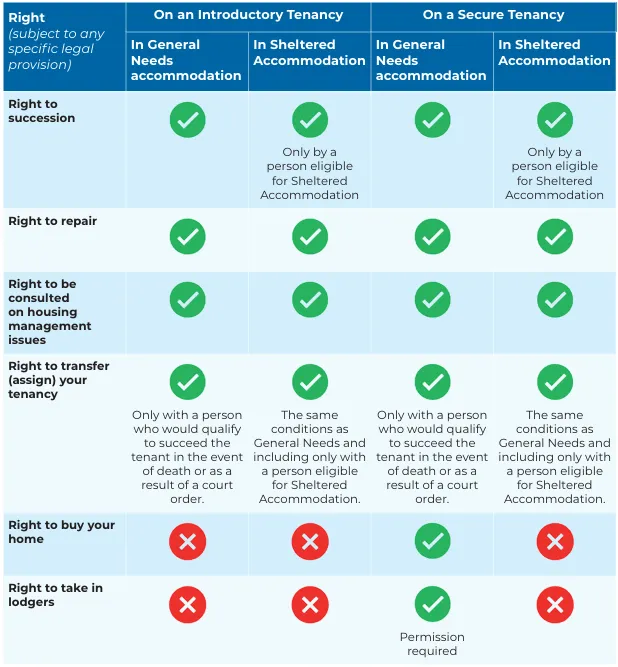
Your rights as a tenant are determined by the type of Tenancy Agreement you have. Below, we have summarised the main rights of residents based on an introductory or secure tenancy. However, you can see your full rights in the Tenancy Agreement above.
| Right (subject to any specific legal provision) | On an Introductory Tenancy | On a Secure Tenancy |
|---|---|---|
| Right to succession | Yes For independent living tenants, this can only be with a person eligible for the scheme | Yes For independent living tenants, this can only be with a person eligible for the scheme |
| Right to repair | Yes | Yes |
| Right to be consulted on housing management issues | Yes | Yes |
| Right to transfer (assign) your tenancy | Yes - only with a person who who would qualify to succeed the tenant in the event of death or as a result of a court order. For independent living tenants, the same conditions apply, but the person must also be eligible for the scheme. | Yes -only with a person who who would qualify to succeed the tenant in the event of death or as a result of a court order. For independent living tenants, the same conditions apply, but the person must also be eligible for the scheme. |
| Right to Buy your home | No | Yes For independent living tenants, the right to buy is prohibited. |
| Right to take in lodgers | No | Yes |
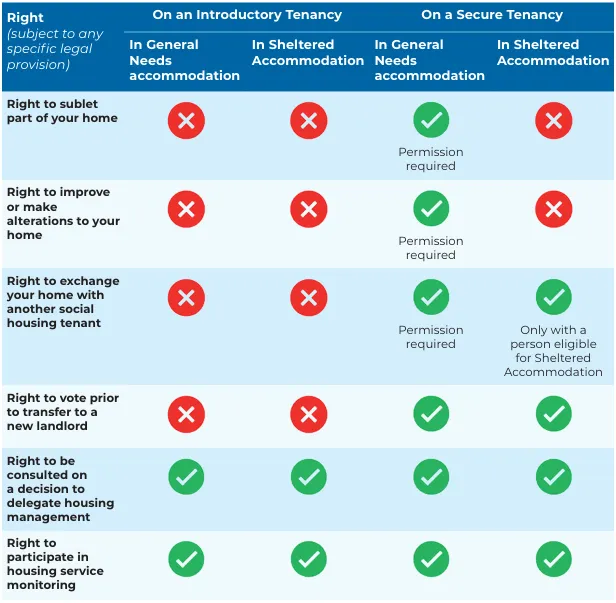
| Right to sublet part of your home | No | Yes - permission is required |
| Right to improve or male alterations to your home | No | Yes - permission is required |
| Right to exchange your home with another social housing tenant | No | Yes - permission is required. For independent living tenants, this can only be with a person eligible for the scheme |
| Right to vote prior to transfer to a new landlord | No | Yes |
| Right to be consulted on a decision to delegate housing management | Yes | Yes |
| Right to participate in housing service monitoring | Yes | Yes |
Keep Me Posted
Sign up for email updates on council services.
Keep Me Posted (opens in new tab)